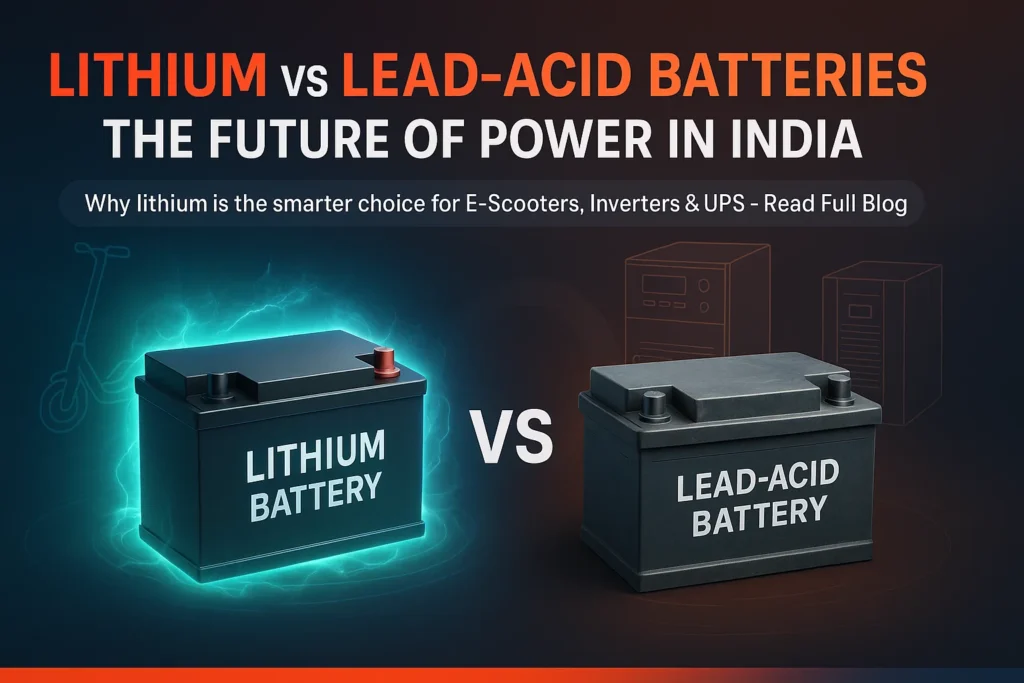
India’s energy and mobility landscape is changing fast. From the growing adoption of electric scooters (EVs) to the rising need for long backup inverters and UPS systems, the demand for reliable batteries has never been higher.
Traditionally, lead-acid batteries were the default choice. But today, lithium-ion (Li-ion) batteries are quickly becoming the preferred solution—offering higher performance, longer life, and better efficiency.
So, what makes lithium batteries the future for e-scooters, inverters, and UPS systems in India? Let’s break it down.
🔋 1. Lifespan & Performance: Lithium Outlasts Lead-Acid
- Lead-Acid Battery: Average lifespan of 2–3 years with frequent maintenance.
- Lithium Battery: Lasts 6–10 years depending on usage, with up to 5x more charge-discharge cycles.
For e-scooters, this means longer rides per charge. For home inverters and UPS, it means consistent backup for years without frequent replacements.
👉 Bottom line: Lithium offers better ROI (return on investment).
⚡ 2. Energy Efficiency & Fast Charging
One of the biggest limitations of lead-acid is slow charging and energy loss.
- Lead-Acid: Takes 8–12 hours for a full charge, with significant energy wasted as heat.
- Lithium: Charges 3x faster and retains 95% efficiency.
For an electric scooter rider, this means you can recharge in just a few hours and get back on the road. For inverter/UPS users, it means quicker readiness during frequent power cuts in Indian households.
🚀 3. Lightweight & Compact Design
- Lead-acid batteries are bulky and heavy, reducing vehicle efficiency and increasing handling difficulty.
- Lithium batteries are 50–60% lighter, making them perfect for foldable e-scooters, compact home inverters, and sleek UPS systems.
In a country like India, where portability and space-saving are key, lithium batteries clearly win.
🌍 4. Eco-Friendliness & Sustainability
India is pushing toward green mobility and clean energy solutions. Lead-acid batteries contain toxic chemicals like lead and sulfuric acid, which pose serious recycling challenges.
Lithium batteries, while not entirely free from environmental concerns, are cleaner, safer, and more recyclable. Plus, their long lifespan reduces overall waste.
💰 5. Cost Factor: Is Lithium Worth the Investment?
Yes, lithium batteries are more expensive upfront. But when you factor in:
✅ Longer life (6–10 years vs. 2–3 years)
✅ Minimal maintenance
✅ Faster charging = lower electricity costs
✅ Better performance
…the lifetime cost of ownership is much lower than lead-acid.
For Indian households and e-scooter owners, this makes lithium a smart, future-ready investment.
📱 6. Smart Features: The Lithium Edge
Modern lithium batteries come with Bluetooth connectivity, real-time monitoring, and smart charging systems. For example:
- Track your e-scooter battery health via a mobile app.
- Monitor inverter backup levels.
- Ensure UPS readiness during critical office work.
Lead-acid batteries simply cannot offer these intelligent features.
✅ Why Lithium Is the Future for India
- For E-Scooters: Longer rides, lightweight, fast charging → perfect for India’s EV revolution.
- For Inverters: Reliable, long backup during power cuts, no maintenance → ideal for Indian homes.
- For UPS: Compact, efficient, and durable → critical for businesses and remote work setups.
With government incentives, EV adoption, and growing energy needs, lithium batteries are set to replace lead-acid across industries.
🔑 Final Thoughts
The era of lead-acid dominance is ending. While they served well in the past, today’s demands for speed, efficiency, sustainability, and intelligence make lithium batteries the future of energy storage in India.
Whether you’re upgrading your electric scooter, securing long inverter backup, or ensuring uninterrupted UPS performance, choosing lithium is the smarter, future-proof decision.
Frequently Asked Questions
Why should Indian homes switch to lithium batteries for inverters?
Lithium batteries last longer, charge faster, require no maintenance, and provide consistent backup during frequent power cuts—making them ideal for Indian homes.
How long does a lithium battery last in a home inverter?
A quality lithium inverter battery can last 6–10 years, compared to just 2–3 years for traditional lead-acid batteries.
Are lithium UPS batteries safe for home use?
Yes. Lithium UPS batteries are completely safe and come with built-in protections against overcharging, overheating, and short circuits.
Do lithium batteries work well in Indian weather conditions?
Absolutely. Lithium batteries are designed to handle hot summers, humid monsoons, and frequent power cuts, making them reliable for Indian households.
Are lithium batteries more expensive than lead-acid?
The upfront cost is higher, but their long lifespan, fast charging, and zero maintenance make lithium batteries cheaper and more cost-effective in the long run.