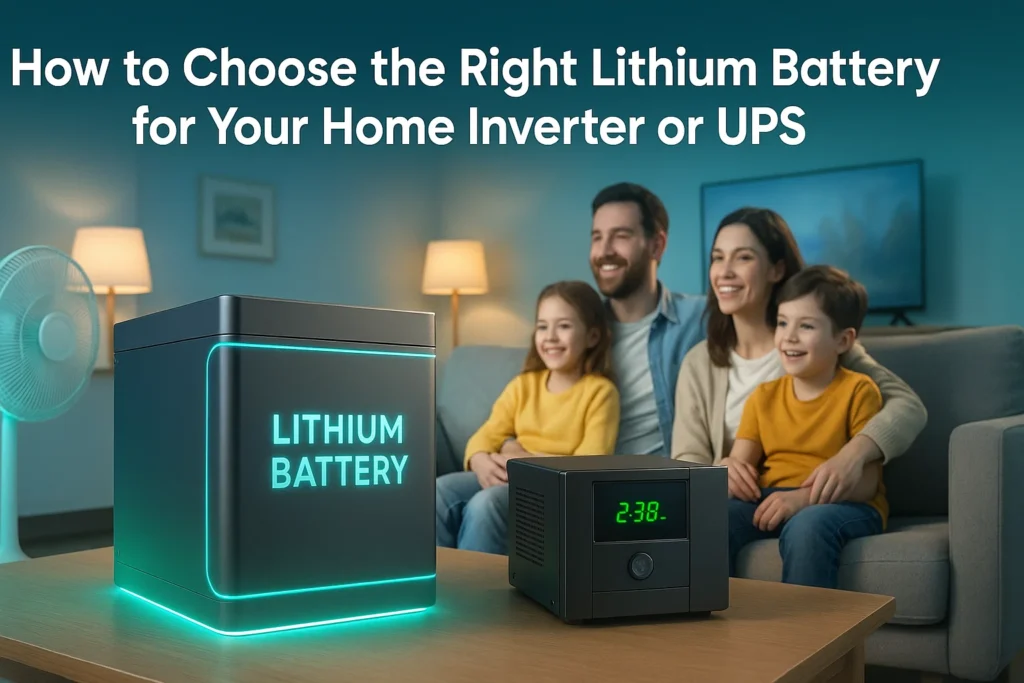
Indian households today face two big challenges: frequent power cuts and increasing energy needs. Whether it’s running fans, lights, and appliances during outages or ensuring Wi-Fi and laptops stay on for work and study, a reliable battery backup is no longer optional—it’s essential.
For decades, lead-acid batteries were the default choice. But now, lithium batteries are taking over—thanks to their long life, fast charging, and maintenance-free design. The key question is: how do you choose the right lithium battery for your home inverter or UPS?
Let’s break it down.
🔋 1. Understand Your Power Needs
Before buying, calculate how much backup you need:
- Small Homes/Flats: Fans, lights, router → A medium-capacity lithium inverter battery is sufficient.
- Large Homes: Fans, lights, TV, fridge, kitchen appliances → Go for a higher-capacity lithium inverter battery.
- Work-from-Home Setup: Laptop, Wi-Fi, printer, lights → Choose a lithium UPS battery with instant switching and reliable backup.
👉 Pro Tip: Always choose a battery with slightly higher capacity than your average requirement. It prevents overloading and extends battery life.
⚡ 2. Check the Battery Capacity & Voltage
Lithium batteries come in different capacities (Ah/Wh) and voltages. The right choice depends on your inverter or UPS model.
- For home inverters, ensure the battery capacity can handle essential household loads.
- For UPS systems, focus on voltage compatibility and instant power delivery.
Always check your inverter/UPS manual or consult a trusted supplier before buying.
🕒 3. Look for Cycle Life & Durability
The true strength of lithium batteries lies in their cycle life.
- Lead-acid batteries: 300–500 cycles (2–3 years).
- Lithium batteries: 2000–3000+ cycles (6–10 years).
That means a lithium battery for your inverter or UPS can last 3–5 times longer, making it far more cost-effective over time.
🛠️ 4. Prioritize Maintenance-Free Design
Unlike lead-acid batteries that need regular water top-ups, lithium batteries are completely maintenance-free.
This is especially useful for:
- Families living in apartments with limited space.
- Elderly users who can’t maintain heavy batteries.
- Busy households that want a plug-and-forget solution.
🌍 5. Consider Safety & Reliability
A good lithium battery for home use should include built-in protections:
- Overcharge & discharge protection.
- Short-circuit and thermal safety.
- Compatibility with Indian climate (heat, humidity, monsoon).
Brands like Spring Power design lithium batteries specifically for Indian conditions, ensuring safe and reliable performance year-round.
💰 6. Factor in Cost vs. Long-Term Value
Yes, lithium batteries cost more upfront. But when you consider:
- 3x longer lifespan
- Zero maintenance costs
- Lower electricity bills (due to higher efficiency)
- Compact, space-saving design
…the lifetime cost of ownership is much lower than lead-acid.
👉 Think of lithium as a one-time smart investment for your home’s future.
🔑 Final Thoughts
Choosing the right lithium battery for your home inverter or UPS comes down to:
- Calculating your power needs.
- Matching the right capacity & voltage.
- Prioritizing durability, safety, and efficiency.
With longer backup, zero maintenance, and unmatched reliability, lithium batteries are the future of home energy in India.
If you want peace of mind during outages, smart savings, and a greener lifestyle, upgrading to a Spring Power lithium battery is the smartest move you can make today.
Frequently Asked Questions
Q1. Which lithium battery is best for home inverters in India?
Lithium batteries with 2000–3000+ cycle life, high efficiency, and built-in safety features are best. Brands like Spring Power offer inverter-compatible lithium batteries designed for Indian households.
Q2. How long does a lithium inverter battery last compared to lead-acid?
A lithium inverter battery lasts 6–10 years (2000+ cycles), while lead-acid typically lasts only 2–3 years.
Q3. Can I use the same lithium battery for both inverter and UPS?
Yes, many lithium batteries are compatible with both, but always check voltage and capacity requirements in your inverter/UPS manual.
Q4. Are lithium inverter batteries safe in Indian summer heat?
Yes. High-quality lithium batteries have thermal management and overcharge protection, making them safe in extreme Indian weather conditions.
Q5. Is a lithium inverter battery worth the higher price?
Absolutely. Though the upfront cost is higher, lithium batteries save money in the long run due to longer lifespan, zero maintenance, and higher efficiency.